

Rede des Botschafters bei der Feier zum Flaggentag der Finnischen Streitkräfte
Rede von Botschafter Okko-Pekka Salmimies bei der Feier zum Flaggentag der Finnischen Streitkräfte am 5. Juni 2026.
Sehr geehrter Brigadier Imoberdorf,
Sehr geehrte Oberst Mägli,
Excellencies,
Meine Damen und Herren,
Warmly welcome to the Finnish Defense Forces’ traditional Flag Day celebration. The actual Flag Day was yesterday, June 4, which is also Marshal Carl Gustav Mannerheim’s birthday.
Marshal Mannerheim is widely regarded as the most important individual figure in the history of independent Finland. Mannerheim was one of the key persons, who laid the groundwork for Finland’s independence, he built the Finnish Army, served as Commander-in-Chief of the Finnish Army during World War II, and, after the war ended, served as President of the Republic of Finland.
This year marks the 75th anniversary of his death. Mannerheim died in Lausanne, and in keeping with a long tradition, tomorrow we will lay wreaths at the monument to Marshal Mannerheim in Montreux, at a ceremony hosted by Colonel Roger Kocher, recently appointed new President of the Finnish-Swiss Officers’ Association.
At this occasion, I want also thank the outgoing President, Colonel-Lieutenant Adreas Suppiger for his tireless years of service.
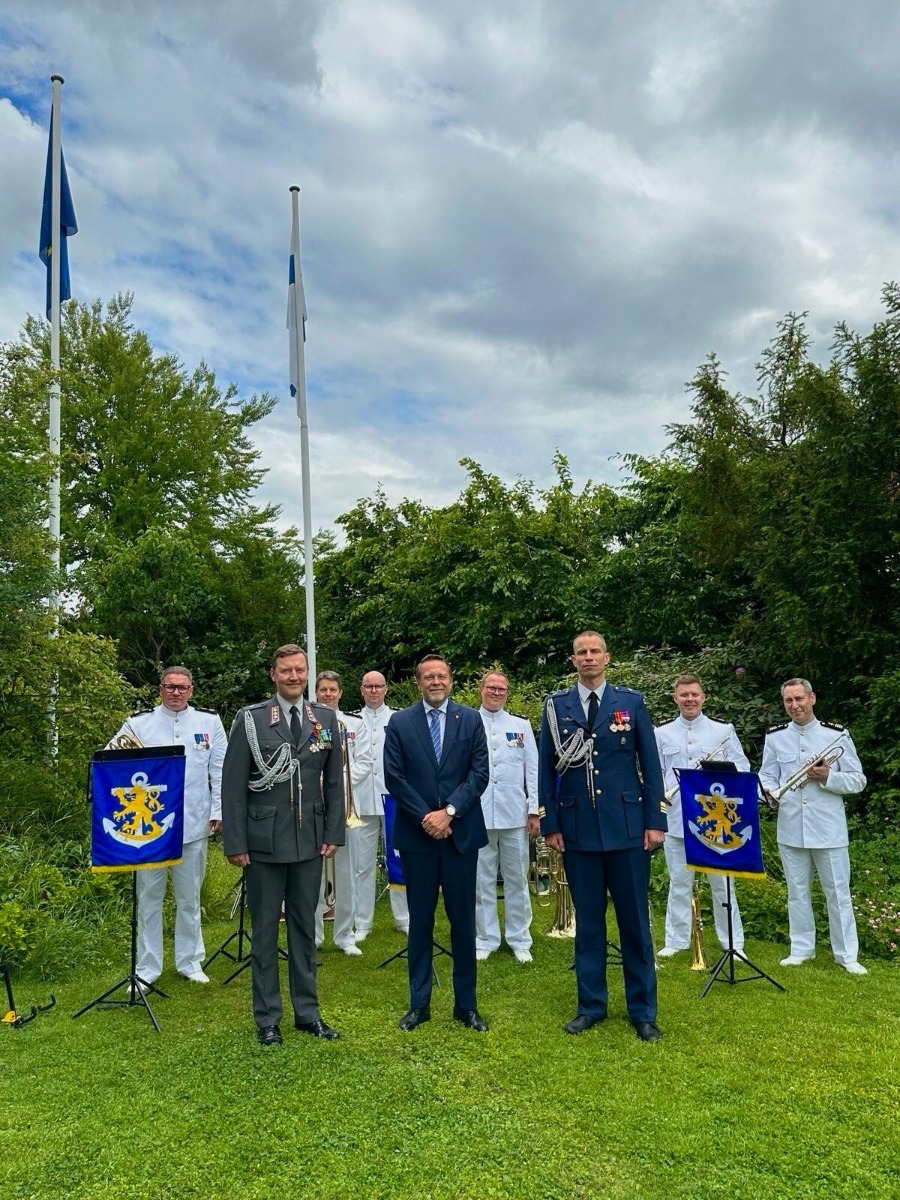
This year also marks the 100th anniversary of bilateral diplomatic relations between Finland and Switzerland. We therefore have good reason to celebrate Flag Day in a particularly festive manner, accompanied by the Finnish Navy Military Band, led by Chief Petty Officer Mikko Perälä.
Distinguished guests,
Finland and Switzerland are both well aware of their own histories, and know ,that safeguarding independence and national sovereignty cannot be left solely to the assumption, that good neighborly relations will endure.
Since the end of World War II, Finland has unwaveringly maintained its own defense capabilities. We remained militarily non-aligned right up until Russia’s 2022 invasion of Ukraine.
As is well known, Finland conducted a swift but thorough assessment of the profoundly changed security environment, and based on that, submitted its application for membership in the NATO, together with Sweden.
The processing time for Finland’s application was the shortest in NATO’s history. The reason for this was clear: our national defense system and capabilities, were well known to the alliance.
Furthermore, Finland had grown closer to NATO through decades of close cooperation with the organization. Finland’s strong independent defense capabilities were seen as strengthening NATO. Finland’s high-quality military training, large reserve force, technological capabilities, and defense industrial capacity have provided added value to the alliance.
Due to the threat posed by Russia, all of Europe is expected to increase individual countries’ contributions, and to intensify cooperation and joint operations. The U.S. announcement to reduce the presence of conventional weapons systems and troops in Europe. is not the root cause of this awakening; it merely underscores this need.
Switzerland is also seeking to increase defense funding in line with the federal government’s proposal.
According to a recent study by the Swiss Military Academy and ETH Zurich, support among voters, for increasing defense spending is also clearly on the rise.
As a result of the clear deterioration in the European security situation, and Russia’s war of aggression against Ukraine continuing, the future of security, stability, and prosperity across all of Europe is at stake.
Politicians, civil servants, researchers, media and voters alike, are grappling with fundamental questions. At the societal level, we are expected to have a collective understanding of the gravity of the situation, and to chart a course for strengthening our defense capabilities. At the individual level, we are expected to shoulder our responsibilities as conscripts, taxpayers, voters, and citizens.
Just over a month ago, the Bern Security Dialogue organized a seminar, aptly and thought-provokingly titled “The Price of Freedom.” Russia’s full-scale, consistent, and brutal war of aggression in Ukraine, now in its fifth year, forces us across Europe to ask, how much we are willing to pay for democracy, the rule of law, human rights, state sovereignty, and territorial integrity.
The actual ability to respond to a hybrid or military attack does not depend solely on the adequacy of financial and material resources.
In addition to the quantitative and qualitative capabilities of weapon systems, the performance of individual soldiers and military units plays a significant, even decisive, role. The foundation of all military performance is the will to defend the country.
In Finland, the will to defend the country among those, who have completed military service, has been measured for decades. During the Russian invasion to Ukraine, and Finland’s NATO membership, the Finnish will to defend the country, has remained strong, and ranks among the highest in Europe. According to an annual survey, approximately 80 percent of Finns, who have completed military service, report that they are prepared to defend their country with arms, even if the outcome is uncertain.
Ladies and Gentlemen,
Finland’s defence system is based on the concept of comprehensive security. It is a deeply rooted whole of society preparedness model, where civil and military authorities, private sector, civil society and media jointly safeguard the country’s vital functions.
The goal is to ensure that the society can anticipate, manage, and recover from disruptions, while maintaining a normal daily life, making Finland one of the most resilient societies in the world.
The resilience of the Finnish society builds on six practical corner stones: 1) Media Literacy, 2) Household readiness, 3) Volunteerism, 4) Civil Defence shelters, 5) Security of Supply and 5) Strong National Defence supported by military partnerships.
The Finnish model and experiences are of keen interest in Switzerland. This is evidenced by visits to Finland in recent months, led by the Swiss Minister of Defense Martin Pfister and the Speaker of Parliament Maja Riniker, focusing exclusively on security and defense. Next week, the Nordic countries will jointly organize a defense policy seminar in Bern titled “Total Defense.”
Finland’s contribution to this seminar will be to present our systems for security of supply and the war economy, through speakers at the highest levels of both the civilian and military sectors.
A delegation from Finland’s National Defense Course will also be visiting Switzerland next week. During this visit, it will be possible to present to the Swiss administration and research community the core of the “whole-of-society preparedness” model of Finland.
Strengthening the bilateral cooperation between Finland and Switzerland is a two-way street of peer learning and doing. Finland is particularly interested to cooperate in matters related to equipment procurement, research and innovation, and critical infrastructure.
Cooperation between the Finnish and Swiss armed forces has a long and established tradition. This cooperation includes, among other things, general and service-specific exchange programs for visits and scholarships. Captain lieutenant Matias Öblom of the Finnish Defense Forces, present today, is currently completing his training course as a guest of the Swiss Army.
Ladies and Gentlemen,
This ceremony also provides an opportunity to bid farewell to Finland’s Military Attaché in Switzerland, Colonel Jukka Mälkki. Colonel Mälkki is stepping down from this post having served his full term, and will continue his foreign service in Brussels after the summer. This occasion also provides an opportunity to welcome his successor, Lieutenant Colonel Marc Fuss.
Before I invite Colonel Mälkki to speak, I would like to thank our partners and sponsors. Particularly Finnair, Finland’s national airline. Finnair has made it possible for us to have the Finnish Navy Military Band perform at our event. I would also like to thank Hätälä Seafood, which has provided us with delicious salmon.
Dear guests,
I hope you enjoy yourselves and appreciate the music of the Navy Band, as well as the salmon sandwiches and two Finnish military-themed beverages: Marshal Mannerheim’s signature schnapps and the beer named after Colonel Sandels, a hero of the 1809 Finnish War.
I would now like to invite Colonel Mälkki to speak.
Thank you for your attention.