

Finland’s quantum expertise can strengthen Europe’s global leadership
Europe has a strong position in quantum technologies. The challenge is to turn scientific excellence into technological leadership, globally competitive businesses and high-value industrial activity. Finland’s quantum ecosystem, combining world-class research, innovative companies and specialised infrastructure, offers valuable expertise to help achieve this goal.
Europe’s experience with cloud infrastructure, semiconductors and artificial intelligence has highlighted the importance of developing critical technologies, strengthening secure and diversified supply chains, and reducing strategic dependencies. In quantum technologies, Europe’s ambition must be not simply to keep pace with global developments, but to achieve global technological leadership by building on its scientific and industrial strengths.
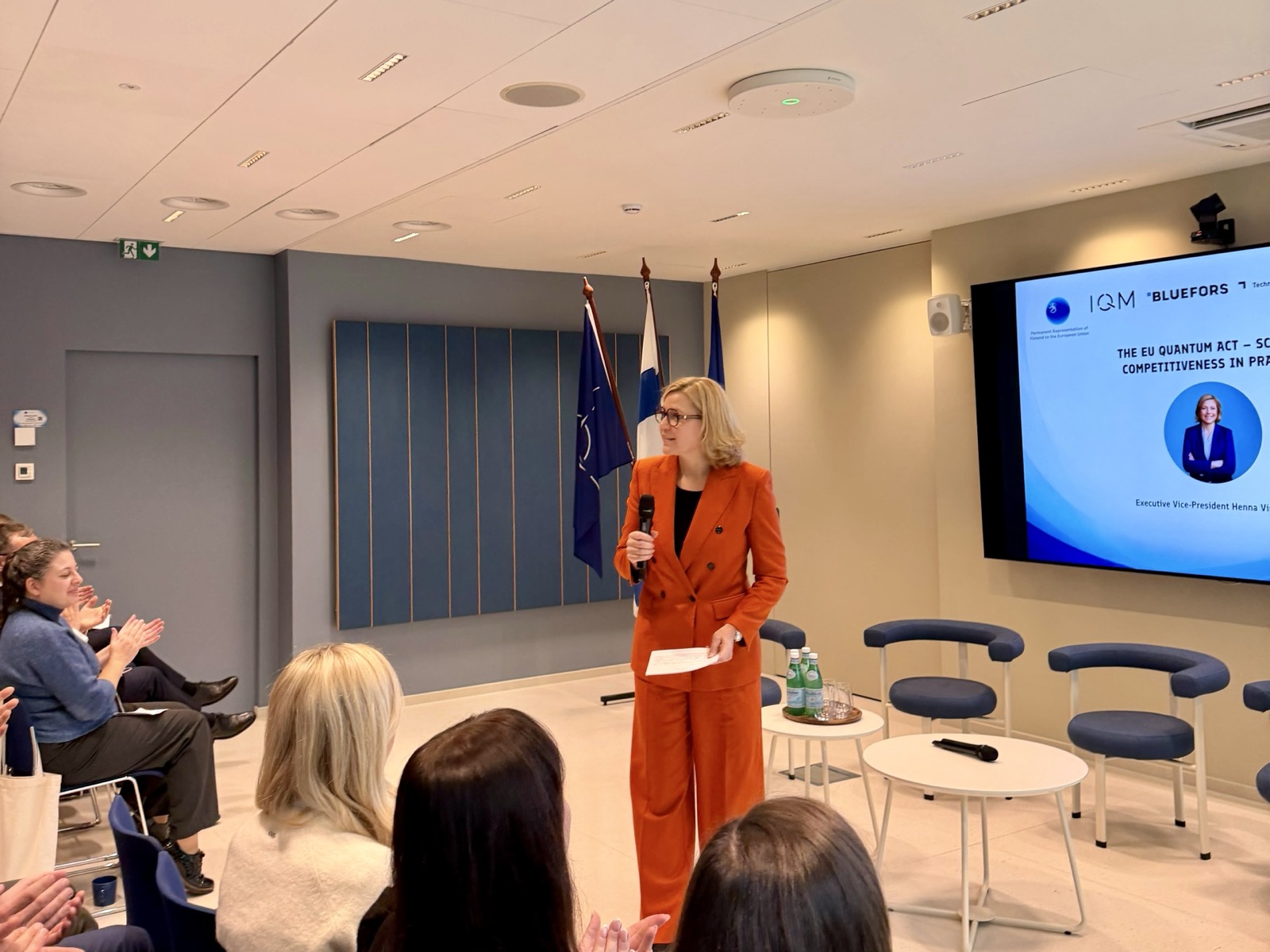
These issues were discussed at a lunch briefing entitled The EU Quantum Act – Scaling Competitiveness in Practice, held at the Permanent Representation of Finland to the EU in Brussels on 22 October 2026. The event brought together EU policymakers, industry leaders and quantum experts to explore how the forthcoming EU Quantum Act can support Europe’s quantum sector and help turn its strengths into industrial growth.
The event was jointly organised by the Permanent Representation of Finland to the EU, IQM Quantum Computers, Bluefors, Technology Industries of Finland and VTT.
The Quantum Act must turn ambition into industrial growth
In his opening remarks, Ambassador Lauri Hirvonen, Deputy Permanent Representative of Finland to the EU, highlighted the strategic importance of critical technologies and the need to combine competitiveness with strategic resilience. He emphasised that the Quantum Act should build on Europe’s existing strengths and help companies scale up and compete internationally.
Achieving this requires a more attractive business environment. Quantum technologies have a wide range of applications in computing, sensing and communications. In these fields, we must strive for global technological leadership, building on our industrial strengths and scientific excellence, while increasing Europe’s role in the value-chains.
Investment across the entire innovation chain is equally important, from research and development to commercialisation and business growth. EU funding should be allocated through open, competitive and excellence-based procedures that leverage private investment. International cooperation with partners should complement these efforts and support Europe’s global ambitions.
Henna Virkkunen, Executive Vice-President of the European Commission for Tech Sovereignty, Security and Democracy, emphasised Europe’s strong foundations in quantum technologies:
“Europe has all the pieces of the puzzle to lead in quantum – the scientific excellence, the talent and the industrial capabilities.”
Finland demonstrates the potential of Europe’s quantum ecosystem
Finland’s quantum ecosystem combines advanced research and commercial capabilities in quantum computing, high-performance computing, AI models and cryogenic cooling solutions, alongside expertise in photonic circuits and chip technologies. Together, these capabilities can help address scientific and industrial challenges that no single technology can solve alone.
Built around world-class research, development and innovation infrastructure, the ecosystem connects scientific excellence with industrial capabilities. It demonstrates how complementary technologies, specialised infrastructure and collaboration between research and industry can support the development and growth of globally competitive companies.
Bringing policy and industry together
The panel brought together perspectives from European policymaking, industry, and research. Participants included Aura Salla, Member of the European Parliament’s Committee on Industry, Research and Energy (ITRE); Jan Goetz, CEO and Co-founder of IQM Quantum Computers; Kim Povlsen, CEO of Bluefors; Erja Turunen, Executive Vice President of VTT; and Roberta Ragaišytė, Attaché for Economic Affairs for Lithuania. Irina Kupiainen, Director of EU Affairs at CSC – IT Center for Science, also delivered remarks. The event was moderated by Joonas Mikkilä, Senior Advisor at Technology Industries of Finland.
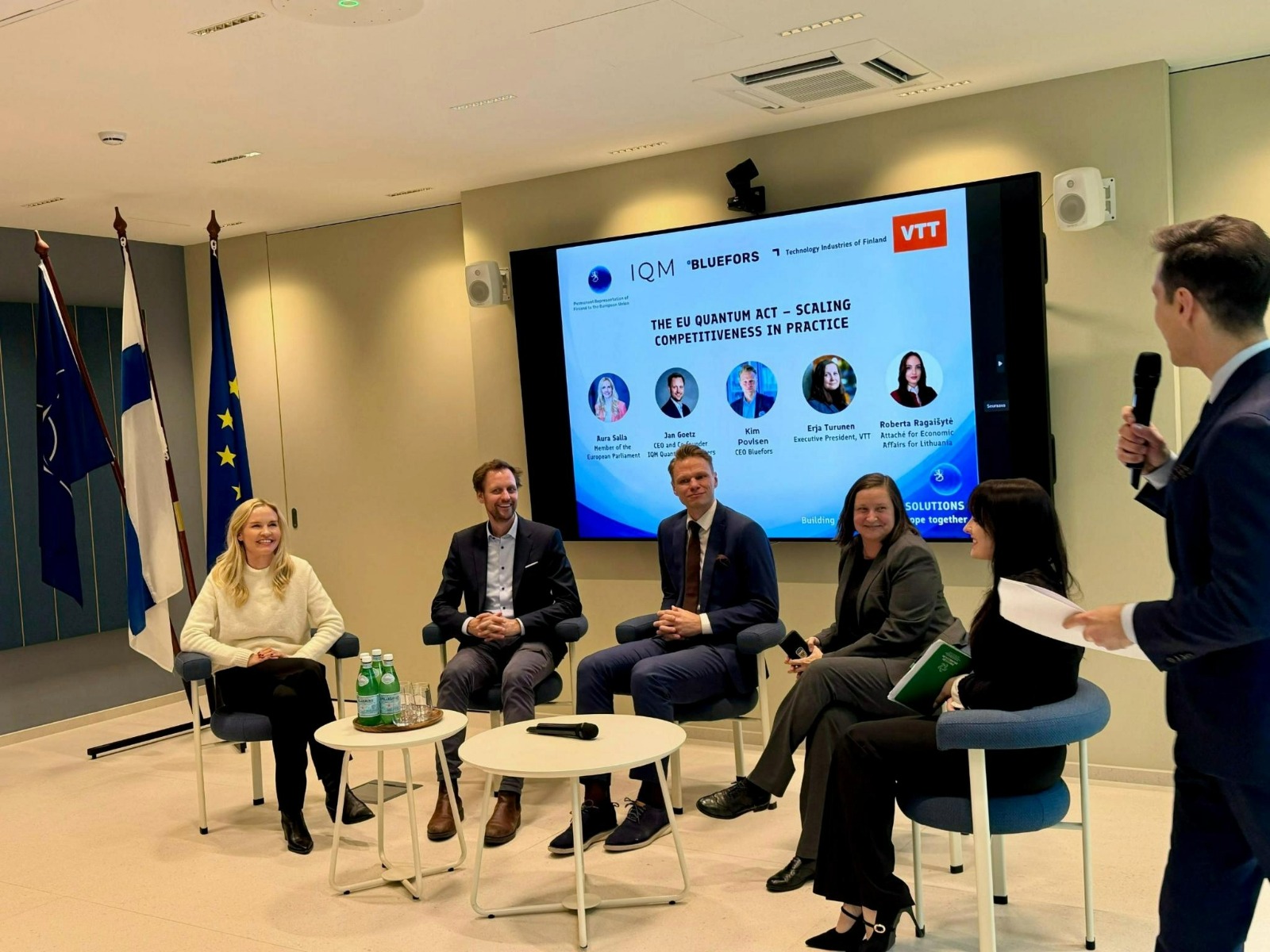
The panel highlighted how the Quantum Act should establish mission-oriented and pre-commercial procurement mechanisms to de-risk the development of flagship systems, and a joint procurement mechanism allowing Member States to pool demand, drawing on precedents such as the LUMI consortium. IQM’s CEO Jan Goetz highlighted how experience shows that product orders are among the strongest levers for attracting private investment.
Both Erja Turunen, during the panel discussion, and Fabian Bohnenberger, Associate Director at DIGITALEUROPE, in his closing remarks, stressed that Europe needs dedicated, industrial-scale quantum chip manufacturing capacity in addition to the existing pilot lines. Extending the first-of-a-kind (FOAK) facility criterion in the Chips Act framework to quantum chip manufacturing would give companies the confidence to invest in fabrication infrastructure in Europe.
The EU Quantum Act offers an opportunity to connect national strengths, mobilise investment and support innovation across the value chain. By creating the conditions for European research and industry to thrive, it can help build globally competitive businesses while strengthening Europe’s competitiveness and strategic resilience.