
Commission representatives introduced to Finland’s bioeconomy
Seven officials from the European Commission visited FInland in mid-June. They were introduced to our bioeconomy, particularly in forestry, but also with a trip to a farm. It was gratifying to see that the sites visited were of such interest that the questions and discussions had to be cut short when it was time to move on. Bioeconomy is one of Finland’s main priorities in lobbying for the agenda of the next European Commission.
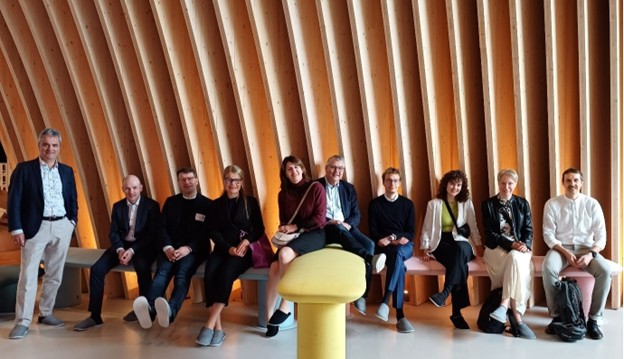
We visited the bioproduct mill of Metsä Group in Äänekoski. Our guests were impressed by the wide range of products that can be derived from wood. The Äänekoski mill produces textile fibres, 3D packaging, pine oil, and sulphuric acid, and generates more than twice the electricity needed to run the mill itself. In a couple of years, a laminated veneer wood mill producing beams and boards will start up in Äänekoski. We also visited a forest to see thinning in progress; this is a process of selective timber harvesting that is necessary to provide the best trees with the nutrients, water and light that they need.
Another stop was at a beef farm at Toivakka near Jyväskylä to see a biogas installation that made the farm self-sufficient for electricity and heating. Extracting gas from manure has the added benefit of removing the smell, and as a by-product the installation yields liquid fertiliser where nitrogen is present in a form that can be more effectively used by plants.
In Helsinki, we visited the magnificent eight-storey wood-built headquarters of the Supercell game company; the architect was available to answer our questions. We then visited the premises of the Finnish Forest Association, which was hosting a New Wood exhibition on innovations in the forest-based bioeconomy. We hope to welcome the New Wood exhibition to Brussels in the autumn.
Arrangements for the trip were made together with the Ministry of Agriculture and Forestry and the Ministry of Economic Affairs and Employment, and our guests met with their senior officials. We were delighted that Metsä Group, Supercell and the Finnish Forest Association laid out the metaphorical red carpet to ensure that the trip was a success.
Contributing to Finland’s bioeconomy lobbying
The bioeconomy is a sector of exceptional importance for Finland. In 2019, this sector generated EUR 26 billion in added value, this being 13% of the total added value generated in the national economy. The goal of Finland’s bioeconomy strategy is to double the added value generated by the bioeconomy by 2035.
Intense bioeconomy lobbying has been going on in Brussels for some time. Finland’s Ministry of Economic Affairs and Employment led the preparation of a position paper on this subject that was joined by six other Member States. A joint message carries much more weight than if Finland were to be pursuing this agenda alone. There is a concerted ongoing effort to include the bioeconomy prominently on the Work Programme of the next Commission.
A statement on the bioeconomy was presented as an information item to the Agriculture and Fisheries Council. The joint statement was signed by 16 Member States, with verbal support provided by six further Member States. This may be considered a major success, because all the large Member States supported the statement either as signatories or verbally. The principal content of the information item was that the bioeconomy must be at the core of the Work Programme of the forthcoming European Commission.
The present Commission began to take a renewed interest in the bioeconomy in its last months in office, after years of dormancy. In March, the Commission issued a communication on biotechnology and biomanufacturing. The Commission has also promised to update the EU Bioeconomy Strategy towards the end of 2025.
A renewed interest has been shown by the Commission’s Directorate General for Internal Market, Industry, Entrepreneurship and SMEs (GROW), with a Deputy Director General actively promoting the bioeconomy. There were two representatives of GROW on the trip reported here.
The Directorate General for Climate Action has also begun to understand that the EU cannot achieve carbon neutrality by 2050 without the bioeconomy. The bioeconomy facilitates carbon storage and replacement of fossil materials and fuels. It is thus crucial for the sustainable use of natural resources and for fostering the diversification of the economy and employment.
Tapio Kytölä