

Joint Statement of Mexico and Finland at the Interactive Dialogue with the Fourth Committee on Overall Policy Matters Pertaining to Special Political Missions
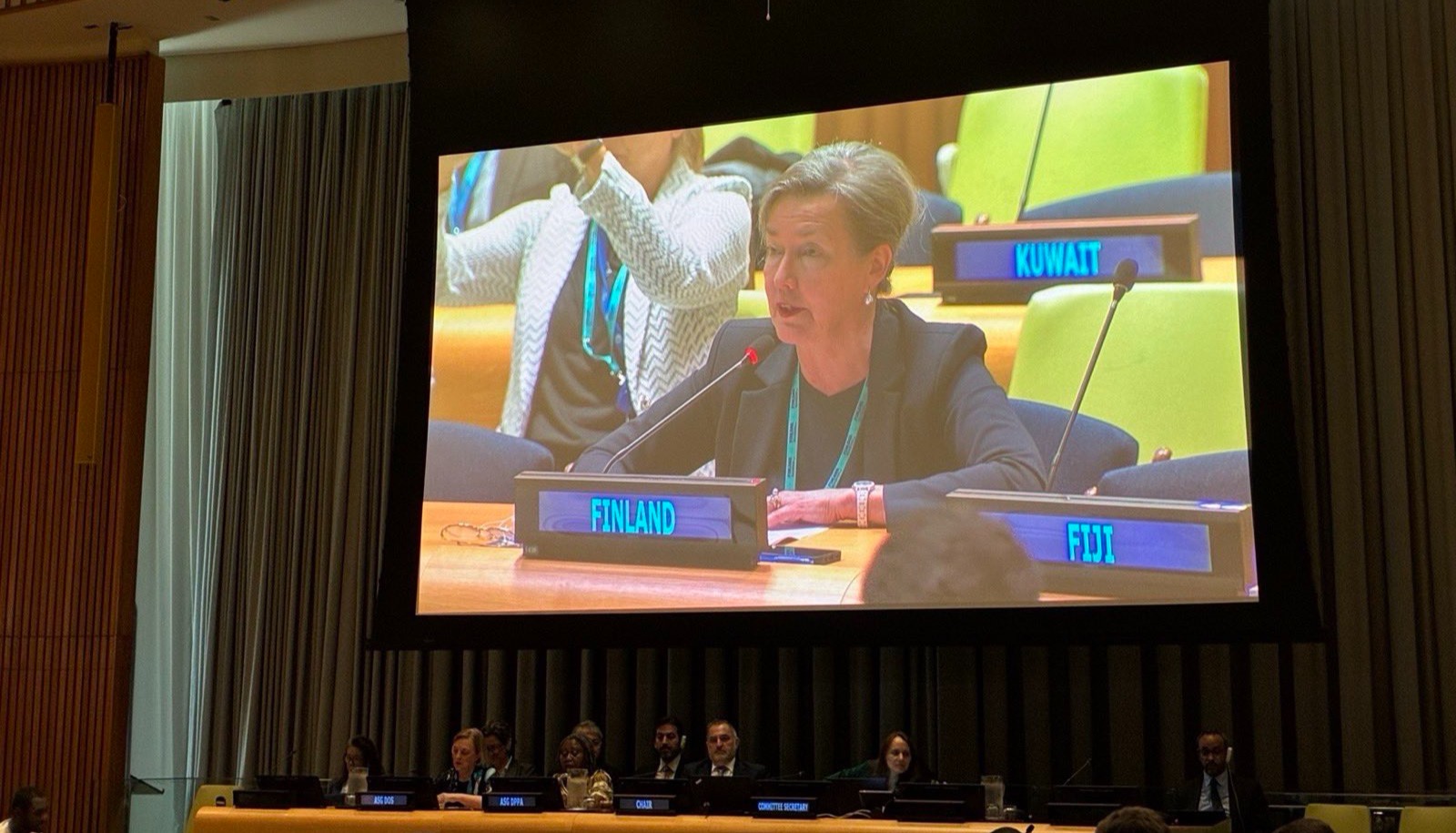
Delivered by Ambassador Elina Kalkku, Permanent Representative of Finland to the UN on July 1st, 2026, in New York.
Muchas Gracias Señor Presidente.
Assistant-Secretaries-General, Colleagues,
I have the honor to deliver this statement on behalf of Mexico and Finland, as the two facilitators of the annual General Assembly resolution on Special Political Missions.
We thank you for convening this interactive dialogue and express our appreciation to the ASGs for their comprehensive and forward-looking introductions.
Mexico and Finland deem it vital that the broadest UN membership at the General Assembly is provided with an annual opportunity to hold an interactive discussion on the UN SPMs. While peacekeeping matters are debated in established formats such as the C-34, UN political missions deserve their own dedicated space for dialogue among the full membership.
This annual exercise reflects a principle that Mexico and Finland have consistently championed: overall policy matters pertaining to SPMs remain a collective responsibility and ownership of all Member States, not solely of those bodies that mandate individual missions.
We welcome the Overview of United Nations Special Political Missions, released by the DPPA yesterday, showing how these Missions have historically helped Member States to transcend divides, reduce tensions, build trust and pursue peace even when global politics are polarized.
The SPMs are elusive to a clear and inclusive definition. They range from sanction-monitoring, preventive diplomacy and peacemaking to multidimensional peacebuilding missions.
Sanction-monitoring incentivizes peace and prevents further escalation through ensuring the effectiveness of UN-mandated targeted measures.
The Secretary-General of the UN has extensive Charter based powers to offer good offices and mediate peace, as well as to lead the UN so that it uses all its instruments, including the SPMs, in a focused and timely fashion wherever UN action is needed. Special or Personal Envoys of the UN Secretary-General also carry out good offices and peacemaking roles and perform key functions of preventive diplomacy.
Field-based Special Political Missions foster peace-making through dialogue and mediation, early-warning through human rights monitoring, and peacebuilding by supporting national post-conflict reforms. The most robust SPMs are multidimensional missions with sizeable security components, such as UNAMA in Afghanistan.
Over the past few decades, these Missions have also been at the forefront of efforts to forge closer partnerships with regional and subregional organizations. They are key partners in conflict prevention, peacemaking and peacebuilding.
Two common denominators exist, however. The SPMs are mandated by the UN Security Council but are not primarily military in their nature. In many respects, the SPMs represent the action for peace as envisaged in the Charter: prevention, de-escalation and dialogue. They indeed show the power of diplomacy.
Their effectiveness continues to depend on mandates that are flexible, adaptable and coherent, guided by sound political analysis and designed to support nationally led, context-specific solutions throughout the peace continuum.
Chair,
The UN has leverage, expertise and a unique position to play a role in conflict resolution and in easing tensions. SPMs harness this peace-making expertise.
Special Political Missions remain among our most effective tools for preventing conflict, sustaining peace, and supporting political transitions. SPMs play a critical role in advancing inclusive peace that benefits all segments of society.
Ensuring the full, equal, safe and meaningful participation of women and youth has long been recognized as key to sustainable and inclusive peace. Empowering women and youth to act as peacemakers increases the longevity of any peace agreement. Last year's commemoration of the twenty-fifth anniversary of Security Council resolution 1325 (2000) on Women, Peace and Security, and the tenth anniversary of resolution 2250 (2025) on Youth, Peace and Security, must continue to be translated into tangible practice within the day-to-day work of Special Political Missions.
Today, the rise of geopolitical tensions and inter-State conflict, the proliferation of non-state armed groups and the change in the information environment all challenge the performance of Special Political Missions. To succeed in their mandates and to navigate the new challenges in the global security landscape, the SPMs need strong political support from Member States and the UN system. It is of the utmost importance to make effective use of the Secretary-General’s good offices and Special and Personal Envoys role, to resume the UN's role as a mediator and guarantor of peace agreements.
This is even more pressing as the Organization implements the UN80 Initiative amid an unprecedented liquidity crisis: efficiency gains across the System must not come at the expense of the political and analytical capacities that make SPMs effective.
Crucially, SPMs rely on strong, unified backing from the Security Council. When Council members speak with clarity and consistency, these missions gain the authority and space they need to mediate, advise, and build confidence among parties.
The General Assembly also has a significant role in providing political support for the SPMs. As the most democratic and representative body of the UN, it can demonstrate the support of the entire membership, signaling to all stakeholders that the international community stands firmly behind peaceful solutions. In this regard, Mexico and Finland reiterate the value of analytical and forward-looking reporting by the Secretary-General that goes beyond a description of all activities undertaken and instead offers concrete recommendations and best practices to inform the membership's future policy guidance.
This analytical support must be sustained. Predictable resources, coherent mandates, and continued political engagement from Member States are essential to ensuring that SPMs can deliver. The recently concluded twin resolutions on the Peacebuilding Architecture Review, adopted alongside this year's first Peacebuilding Week and the twentieth anniversary of the peacebuilding architecture, together with the Secretary-General's ongoing review on the future of all forms of UN peace operations, mandated by the Pact for the Future, offer a timely opportunity to strengthen coherence between SPMs and the broader peace and security architecture.
Mexico and Finland look forward to these processes being duly reflected in the Fourth Committee's continued work.
Chair, Colleagues,
Let us take this opportunity to reaffirm, today, that we stand united behind the Special Political Missions, which embody the UN’s commitment to sustained peace.
I thank you.