
European Council: Defence strengthened, support for Ukraine, aid demanded for Gaza
EU leaders met in late June to discuss the security and foreign policy of the EU under increasingly tense geopolitical circumstances. The summit emphasised both rapid boosting of defence capability and the continuing provision of a wide range of support for Ukraine. Crises in the Middle East, Iran’s nuclear threat and global relationships of the EU were also prominently featured in discussions.
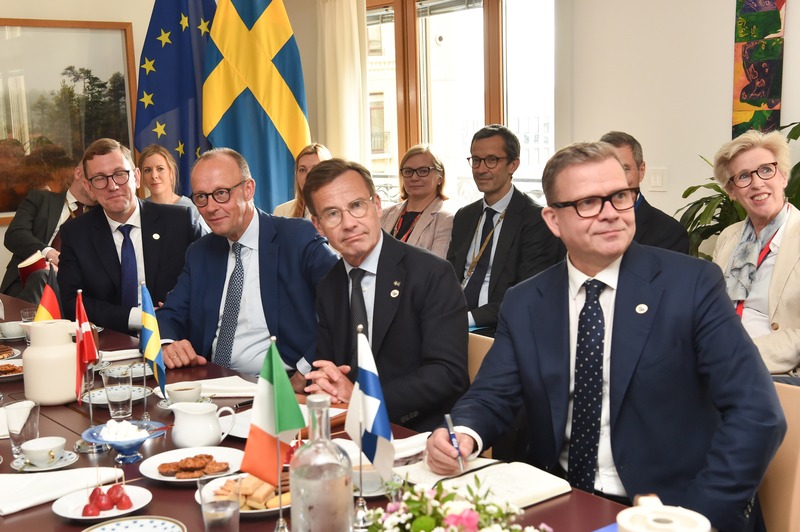
At the European Council summit on 26 June, EU leaders agreed on the continued providing of a wide range of support for Ukraine and for accelerated development of European defence capability. Strengthening the defence of the EU was seen as a necessary response to escalating threats.
“We are boosting our defence capability specifically because of the threat of Russia. It is now the turn of the EU to support its Member States in every way to achieve this goal. Europe must become strong enough to defend itself within a couple of years,” says Prime Minister Petteri Orpo, who represented Finland at the summit.
The EU reaffirmed its commitment to significantly increase its defence capability over the next five years. An added boost was given by the policy outcomes of the NATO summit held at the Hague in the same week.
Ukrainian President Volodymyr Zelenskyi attended the summit via video link. The leaders underlined that economic, political and military support for Ukraine will continue. Prime Minister Orpo stressed that we must not forget about Ukraine:
“Russia is waging war on the European mainland. It is therefore vital to continue to support Ukraine in every way. We must also actively promote the accession of Ukraine to the EU.”
European Council: Aid must be allowed to reach Gaza – increasing violence on the West Bank is also concerning
The situation in the Middle East, particularly in Gaza and on the West Bank, was a major topic of discussion at the summit. The EU expressed its profound concern for the suffering of civilians in Gaza and demanded an immediate humanitarian ceasefire and unrestricted access for aid to reach the enclave.
“The war and civilian suffering must stop. Israel must ensure unrestricted access for humanitarian aid to Gaza, in compliance with international humanitarian law,” said Prime Minister Petteri Orpo.
The EU condemned the strikes made by Hamas and demanded release of the hostages but also stressed that Israel has a duty to act proporationally and in compliance with international law. Increased violence on the West Bank and forced relocations of Palestinian civilians are also causes for concern.
The European Council exhorts Israel to end the blockade of Gaza, to allow access for humanitarian aid and to ensure that aid organisations can operate without hindrance, reminding Israel that the EU may consider further action in respect of agreements between Israel and the EU according to how the situation develops.
The EU also calls for restrictions both on extremists in the Israeli settlements on the West Bank and on Hamas in order to prevent escalations.
EU: iran must not gain nuclear weapons
The EU leaders expressed their satisfaction at the cessation of hostilities and emphasised the importance of international law, restraint and responsibility in cooling down tensions between Iran and Israel.
They committed to continuing diplomatic efforts to diffuse those tensions and to find a sustainable solution for Iran’s nuclear programme. The EU continues to stress that Iran must not under any circumstances be allowed to gain nuclear weapons and requires Iran to comply with the terms of the nuclear non-proliferation agreement. The EU continues to provide humanitarian aid to Palestinians.
EU global relations and competitiveness addressed
The summit involved broad discussions of the relations between EU and the rest of the world, ongoing trade negotiations and how to boost the competitiveness of the EU. Prime Minister Orpo underlined the importance of the rapid deployment of the Single Market Strategy in particular.
“We must focus on removing barriers within the single market and to simplify unnecessray regulation.”
Orpo also pledged support to the EU’s ongoing trade negotiations and asserted the EU’s capability to defend its interests:
“Negotiations must continue, but the EU must also prepare to take rapid action if agreement cannot be reached.”
The summit also included discussions on hybrid influencing, internal security and preparation against hybrid threats. Other key topics included migration, closer relations between the EU and the countries of the West Balkans, and support for Moldova. The leaders confirmed that their shared intent is to make the EU geopolitically stronger and a more coherent and effective international player.
Further information:
Outcomes and conclusions of the European Council summit: https://www.consilium.europa.eu/en/meetings/european-council/2025/06/26/
Government press release: https://valtioneuvosto.fi/-/eu-maat-jatkavat-ukrainan-tukemista-ja-euroopan-puolustuksen-kehittamista